From Sevilla to Implementation: Financing Rights Beyond Business as Usual
The global debates on debt, tax, climate finance, and democratic economic governance between the IMF/World Bank Spring Meetings and the 2026 FfD Forum and where we go from here
By: Mahinour EBadrawi, Global Partnerships Lead
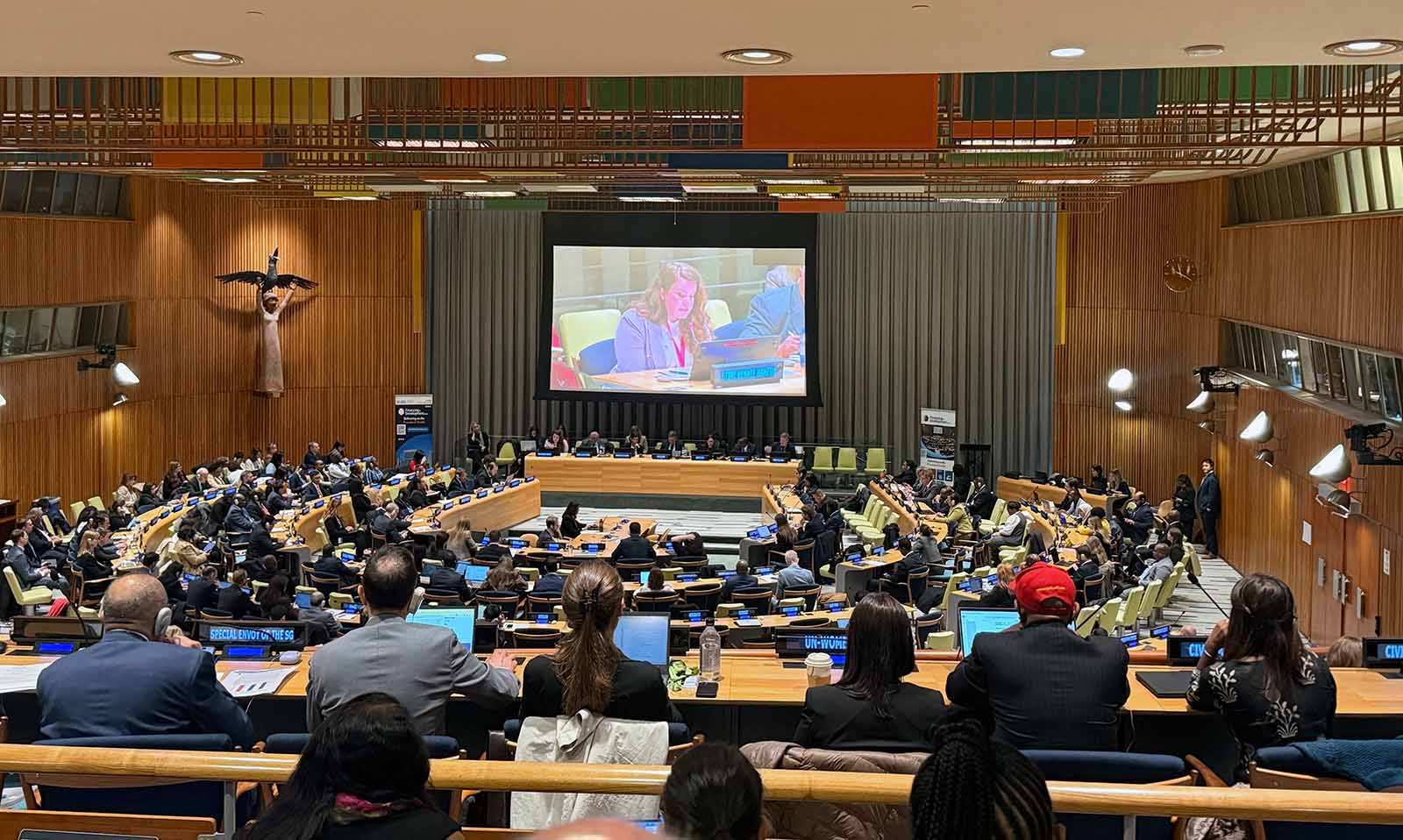
The April 2026 IMF and World Bank Spring Meetings in Washington, DC, and the ECOSOC Financing for Development Forum in New York (the first since the ‘FfD4’ conference and resulting ‘Seville Commitment’) revealed more than just a financing gap. Together, they exposed a stark governance gap between the scale of today’s crises and the willingness of the international system to redistribute power, resources, and accountability.
These reflections reflect on the two spaces together because they are politically connected. Washington remains a key site where creditor power, surveillance, lending, and private-capital models continue to shape the terms of economic policy. New York remains the contested UN space where Global South governments, civil society, feminist movements, and rights advocates are pushing to rewrite those terms through debt justice, tax justice, climate justice, and democratic global economic governance.
The question is not only whether international institutions can survive geopolitical fragmentation. It is what kind of global order is emerging from the rules, silences, and compromises they make. Will it be an order where states uphold obligations to people and the planet, regulate private power, and protect the public good? Or will it be one where oligarchic interests, creditor priorities, and market discipline continue to hollow out democratic accountability?
War, ecological harm, debt distress, and austerity make this question urgent. Militarization and extractive economic policies are not external to financing for development. They shape whether public resources are directed toward rights-based public investment, climate action, social protection, and public services, or toward war, creditor repayment, fossil fuel dependency, and private returns.
For CESR, the issue is not simply whether more financing can be mobilized. It is the question of financing for what, for whom, and under whose rules. A rights-based approach to financing for development requires states to mobilize the maximum available resources, individually and through international cooperation, to fulfill economic, social, and environmental rights. It also requires states to avoid retrogression, tackle inequality and discrimination, regulate private power, and ensure that economic governance is democratic, transparent, and accountable.
That is the test against which post-Sevilla implementation must be judged.
The disconnect between crisis and implementation
The 2026 FfD Forum should have marked a shift from political commitments to implementation. Instead, it revealed a deeper disconnect between the scale of the current crisis and the way the international system continues to organize its response.
The official program was structured around a pre-established review cycle, focused on trade, private finance, and data and follow-up. These issues matter. But the realities shaping the Forum were broader and more urgent: the collapse in official development assistance, deepening debt distress, negotiations toward a UN Framework Tax Convention, the economic and ecological impacts of war, and the wider undermining of the UN system itself.
The negotiations themselves showed that the official agenda could not respond adequately to the politics of the moment. Paragraph 4, on the economic fallout of conflict, became necessary because the context of war could not be kept outside the room. Paragraph 15, on international tax cooperation, exposed the continued struggle over whether the UN Framework Tax Convention will become the center of gravity for global tax rulemaking, or whether its ambition will be diluted by parallel processes dominated by richer countries. And the continued resistance around paragraph 50(f) of the Sevilla Commitment, on an intergovernmental process toward a UN-led debt framework, shows that implementation remains contested precisely where power is most at stake.
These were not drafting debates but rather negotiations over whether implementation would mean confronting power, or simply reframing Sevilla in less contentious terms.
This disconnect matters because implementation cannot become a procedural slogan. Implementation of what, by whom, and for whom must be the starting question. A rights-based implementation agenda must measure progress not by the number of initiatives launched, but by whether they expand fiscal space, redistribute resources, strengthen public accountability, and enable states to fulfill their obligations to people and planet.
As CESR argued in our post-Sevilla reflection, the ‘Compromiso de Sevilla’ (Seville Commitment) is a building block, not a destination. It created openings for rights-based financing, including on progressive taxation, debt reform, gender-responsive policies, and systemic reform, but it remained far short of the transformation civil society and feminist movements have demanded. CESR’s earlier analysis of the “cautious consensus” pointed to the same tension: Sevilla opened pathways for debt and tax reform, but those pathways will only matter if advocates use them to push beyond the limits of the compromise.
The Civil Society FfD Mechanism has been clear that the FfD process must advance human rights, gender equality, wellbeing, socioeconomic and environmental justice, and systemic transformation of the global financial architecture. The Seville Commitment cannot be treated as the ceiling of ambition. Its value lies in whether it can be used to advance structural demands that remain urgent: a UN-led debt framework, a robust UN Framework Tax Convention, reversal of ODA decline, grant-based climate finance, democratic governance of international financial institutions, and public financing for care, social protection, public services, and climate justice.
The 2026 Forum did not resolve the gap between Sevilla’s openings and the scale of reform required. It exposed it.
ODA, militarism, and the politics of scarcity
The credibility crisis of multilateralism is clearest in the contrast between collapsing ODA and expanding militarism.
At the very moment governments were speaking about implementation, ODA was falling sharply, with least developed countries disproportionately affected. This is not a technical budget adjustment. It is a political choice with direct consequences for rights, especially in countries where development cooperation remains vital for health, education, social protection, public investment, and climate resilience.
The contrast with military spending and war-related expenditures is impossible to ignore. Resources are treated as scarce when it comes to care systems, climate adaptation, public services, and social protection, but politically available when directed toward militarization, border regimes, fossil fuel security, and creditor repayment.
From a rights-based perspective, public budgets are not neutral. Cuts to aid, expanded military budgets, debt service, and public guarantees for private returns are distributional choices, and must be judged against obligations of international cooperation, non-retrogression, equality, and minimum essential levels of rights.
As CESR emphasized at the FfD Forum, the crisis of financing cannot be separated from the war economy, shrinking fiscal space, and the erosion of states’ obligations to people and planet.
The politics of scarcity must therefore be challenged as a politics of choice. If public resources can be mobilized for war, fossil fuel subsidies, and creditor repayment, they can also be mobilized for care, climate action, public services, and rights.
Debt: borrower coordination is a win, but not a debt architecture
The fact that debt could not be kept off the table, despite not being a formal review area, reveals the limits of a process that tries to manage development finance through agenda cycles while countries face immediate fiscal crises.
The launch of the Borrowers Platform is a major win for the FfD process and a seed of potential for leveling the playing field in an architecture historically skewed toward creditor interests. Power in the global economic architecture is far from democratic and its redistribution constantly resisted. This platform reflects years of tireless work by debt justice movements, civil society allies, and Global South states asserting their right to development. It creates space for borrower coordination, collective agenda-setting, and more democratic global economic governance. It is a first step toward shifting the rules of sovereign borrowing and lending away from creditor-dominated spaces and toward greater transparency, accountability, and equality.
But borrower coordination is only a first step toward debt justice. It does not replace the need for a UN-led, binding, multilateral debt framework. As our partners at Latindadd and Eurodad have emphasized, debt remains one of the central battlegrounds of FfD4 and its follow-up. The continued resistance around paragraph 50(f) of the Seville Commitment makes this clear: the fight is not only over debt relief, but over where debt rules are made, who gets to participate, and whether debtor countries can shape the architecture that governs their fiscal futures.
From a rights-based perspective, the debt question is not simply whether countries can repay. It is whether repayment is being prioritized over rights. Debt sustainability assessments that ignore health systems, care needs, climate adaptation, food security, housing, education, and social protection are not neutral. They embed a creditor’s view of sustainability while erasing the conditions required for people to live with dignity.
This is why CESR and partners continue to support the long-standing civil society demand for a UN-led debt framework capable of delivering debt cancellation, fair and timely restructuring, automatic debt service suspension in times of crisis, and debt sustainability assessments grounded in human rights, gender equality, climate obligations, and development needs. CESR’s publication, Rethinking Global Debt Restructuring: CESR’s Rights-Based Approach for a Just Financial Architecture, sets out why sovereign debt restructuring must be assessed through human rights standards, not only through creditor recovery and repayment capacity. Such an approach must be guided by human rights principles of maximum available resources, non-retrogression, equality and non-discrimination, participation, transparency, and accountability, while accounting for the gendered impacts of debt and austerity on women’s economic and social rights, public services, care systems, and substantive equality.
The Borrowers Platform is therefore an opening, but the test is whether it strengthens borrower power toward a binding UN-led debt framework, not whether it becomes another consultative space around a creditor-led system. Civil society’s demand for a UN Debt Framework Convention is possible, but only if this opening is used to shift power, not simply to manage crises.
IMF governance and the non-harm test
The same disconnect was visible in Washington. The IMF and World Bank acknowledged a deepening global crisis, but the dominant response remained overly tied to the same tools: leverage, lending, surveillance, private capital mobilization, and incremental governance reform. Eurodad’s Spring Meetings response warned that the institutions were sounding the alarm while continuing to promote policies that risk worsening the situation.
This was the contradiction CESR and partners brought into the Civil Society Policy Forum session, “Strained Multilateralism: Post-Seville Commitments, IMF Responsibilities and a Rights-Aligned Economic Order”. The session asked what it would mean for the IMF to take post-Sevilla commitments seriously and align its surveillance, lending, policy advice, and governance with a rights-aligned economic order.
IMF governance is not a side issue. It determines whose economic worldview becomes policy advice and whose rights are made negotiable in the name of stability. The question is not representation for its own sake. It is whether the institutions shaping public budgets, fiscal space, and macroeconomic policy are accountable to the countries and communities most affected by their decisions.
The Diriyah Guiding Principles, endorsed in the context of IMF quota and governance reform discussions, point to the continued relevance of representativeness and legitimacy. But principles alone are not enough. The test is whether they lead to meaningful quota and voting power reform, especially as discussions continue under the 17th General Review of Quotas and beyond.
International financial institutions must stop reinforcing harmful constraints through business as usual. This requires a non-harm test: do IMF and World Bank policies expand or constrain the resources and policy space states need to fulfill rights? This is especially critical for IMF surveillance. Article IV consultations and related policy advice should be judged not only by narrow stability indicators, but by whether they protect minimum essential levels of rights, preserve space for public investment, and avoid pushing the costs of adjustment onto people already facing discrimination and exclusion. Indeed, the policy prescriptions of international financial institutions must ultimately be judged according to their compatibility with human rights standards.
Ultimately, the governance question is also a rights question. If we want to change the rules of the global economy, we must change who has the power to write them. That means shifting power away from creditor-dominated spaces and toward the people, countries, and communities who pay the price.
The UN Tax Convention: where multilateralism can still move
Tax is where the duty to mobilize maximum available resources becomes concrete. But that duty cannot be fulfilled in a global tax system that enables corporate profit shifting, illicit financial flows, harmful tax competition, and the undertaxation of wealth and capital.
This is why paragraph 15 matters politically. The debate over international tax cooperation is not simply about technical coordination. It is about whether the UN Tax Convention will redistribute rulemaking power toward a more universal and democratic process, or maintain the existing imbalance between OECD-led spaces and the UN albeit with softer language.
The UN Tax Convention remains one of the most important openings in the current landscape. CESR’s latest analysis of UNTC submissions shows familiar fault lines and emerging debates over ambition, corporate taxation, illicit financial flows, equity, human rights, and development needs. The process shows that democratic global economic governance is still possible in UN spaces, even when powerful states resist or refuse to engage.
For CESR, the Convention is not only about technical tax cooperation. It is a question of whether states can mobilize resources progressively and collectively, and whether countries of the Global South can participate on equal footing in writing the rules that shape their fiscal space.
Attempts to dilute the role of the UN, or to place OECD-led processes on a par with the emerging UN convention, are not technical disagreements. They are political choices about who gets to write the rules. As the Global Alliance for Tax Justice has argued, tax justice is key to delivering resources for public services, development, human rights, gender equality, and climate action.
A rights-based tax agenda must be progressive, redistributive, gender-responsive, and internationally coordinated. It must shift the burden away from low-income households, informal workers, and women, and toward those with the greatest ability to pay, including multinational corporations, high-net-worth individuals, and actors profiting from crises.
The path from Seville to New York and then to Nairobi later this year is therefore central. The UN Tax Convention negotiations represent one of the most significant shifts in global economic governance in decades because they move global tax rulemaking from exclusive spaces toward the UN, where countries of the Global South have a more equal voice. The UN Tax Convention is not only a tax process. It is a test of whether multilateralism can more fairly redistribute rulemaking power.
Climate, fossil fuels, and private finance: rights are not bankable assets
The investor-heavy approach to implementation is one of the clearest signs of business as usual. The issue is not whether private actors can ever play a role in development. It is whether the global financing agenda continues to organize public policy around investor confidence while leaving accountability, redistribution, and rights as afterthoughts.
CESR’s post-Sevilla analysis already identified this tension in the Sevilla Platforms for Action, where many initiatives reflected private sector-led approaches to de-risking and blended finance, while more transformative proposals, such as wealth taxation and stronger tax administration, pointed toward a different path. The 2026 Forum did not resolve this tension. Private actors may have roles to play, but they do not hold the social contract. States do. States cannot outsource their obligations to markets that are neither democratically accountable nor bound to prioritize people and planet. The question is not whether investors are present, but whether public policy is being organized around their profits or around states’ obligations.
Climate finance must also be judged by a rights-based test: does it expand fiscal space for a just transition, or does it reproduce debt and dependency? For countries already facing debt distress, climate finance that comes in the form of loans is not meaningful climate justice. It is climate finance on creditors’ terms.
Climate finance also cannot be separated from the care economy. As climate shocks intensify and public systems are weakened by debt, households and communities absorb the costs. A just transition is a hollow promise if it does not include public financing for care systems and social protection as part of climate resilience, rather than treating them as secondary priorities.
The ecological impact of war must also be named. Militarization destroys ecosystems, contaminates land and water, accelerates emissions, diverts resources from climate action, and entrenches fossil fuel dependency under the language of energy security. This is why the financing for development agenda cannot be separated from climate justice or from the growing calls for a Fossil Fuel Treaty.
The momentum from Belém to Santa Marta shows that countries and movements are no longer only asking whether the world should transition away from fossil fuels, but how to do so in a way that is rights-based, fully funded, equitable, and just.
A rights-based, decolonial, feminist, and green agenda requires public, grant-based, additional, accessible, non-debt-creating, and gender-responsive climate finance. It must support adaptation, loss and damage, just transition, care systems, food sovereignty, public services, and community-led resilience. It must also confront the debt and tax rules that push countries toward extractive development pathways in order to preserve fiscal space.
Feminist economic justice: the measure of transformation
Feminist economic justice is not a thematic add-on to financing for development. It is the measure of whether the agenda is transformative at all. Feminist financing for development is therefore not about adding gender language to existing economic models. It is about transforming what the economy is organized to do.
CESR stands with feminist and civil society partners calling for cancellation of illegitimate and unsustainable debt, rejection of austerity and structural adjustment, tax justice, public investment in care, direct grant-based climate finance, reparations for historical and ecological injustices, a binding sovereign debt framework, and democratic governance of financial institutions. As WEDO and other feminist advocates have emphasized, gender language cannot substitute for macroeconomic transformation. Without reforms to debt, tax, climate finance, care, and public services, gender commitments remain vulnerable to the very economic rules that undermine them.
A rights-based feminist agenda starts from the sustainability of life, not the protection of profit. It requires debt cancellation, progressive taxation, universal social protection, decent work, public care systems, bodily autonomy, grant-based climate finance, and an end to austerity. Without these shifts, commitments to gender equality remain rhetorical, while the costs of crisis continue to be absorbed by women, girls, gender-diverse people, and marginalized communities.
Feminist economic justice is therefore not only about who is included in the economy. It is about changing what the economy is organized to do.
Where we go from here
The task now is to turn post-Sevilla implementation into a site of struggle, not a box-ticking exercise. That means using every opening, from the Borrowers Platform and the UN Tax Convention negotiations to COP30, the next FfD Forum, and ongoing debates on IMF governance, to push for a financing agenda grounded in redistribution, public accountability, and rights.
In this moment of contention, Global North governments must stop using “implementation” as a way to narrow ambition. They should reverse the decline in ODA, support paragraph 50(f) and a genuinely UN-led debt process, engage constructively with paragraph 15 through an ambitious UN Framework Tax Convention, and ensure that paragraph 4’s recognition of conflict-related economic harms leads to real financing responses for affected countries. They must also back public and grant-based climate finance and stop using public resources to de-risk private returns while public systems remain underfunded. This is the minimum test of whether post-Sevilla implementation is being treated as a responsibility, not a slogan.
For CESR, the path forward is clear: defend the UN as a space for democratic economic rulemaking, strengthen collective pressure for a binding debt framework and progressive global tax rules, demand public and grant-based climate finance, regulate private power, and ensure that feminist, decolonial, and ecological justice shape the terms of implementation.
The FfD process must now move from repetition to redistribution, from voluntary initiatives to accountability, and from narrow financing fixes to a rights-based transformation of the global economy. The Borrowers Platform, the UN Framework Tax Convention negotiations, and renewed momentum around debt architecture reform show that openings exist, but they will only matter if they are used to shift power. At a moment when war economies are devastating people and the planet, implementation cannot mean business as usual. It must mean building a multilateral order where states uphold their obligations, a rights-based economy where public resources serve public goods, and the rights and dignity of people and planet come before private profit.
Anything less risks turning multilateralism into a language of managed decline. The moment demands more: a global economic order that treats care, dignity, equality, wellbeing, and ecological integrity as the foundations of development.